
Editor’s Note & Courtesy: This beautiful account and the accompanying photographs of the residence and vehicle of Ḥaḍrat Wāṣif ‘Alī Wāṣif were shared by one of his close companions and devoted followers, Khushī Muḥammad. We are deeply grateful to him for preserving and sharing this invaluable memory.
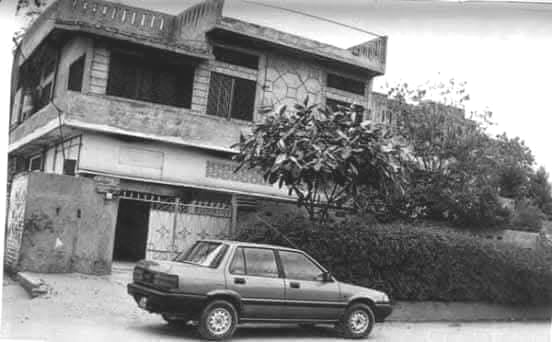

This vehicle was owned by Sarkār Imām-i Martabat Ḥaḍrat Wāṣif ‘Alī Wāṣif (may Allah bless his soul), who utilized it until his apparent departure from this temporary world in 1993. The sight of it brings to mind a memorable incident that truly deserves to be shared with all of you.
Almighty Allah had graced him with the divine faculty to perceive the innermost feelings of his companions and read their unexpressed thoughts. Although he himself never claimed to possess such spiritual powers, his lovers and disciples experienced countless instances of this insight.
It was around 1990 when I was residing in Firdous Colony, Gulshan-i Rāwī, Lāhore. My home was situated just across a small fifty-meter park, directly facing Sarkār’s residence at 22 Firdous Colony. One morning around 10:00 AM, while standing beside this historic car with Sarkār Wāṣif-i Bā-Ṣafā, a fleeting thought crossed my mind:
“I do not even own a motorbike, yet Wāṣif Ṣāḥib keeps a car. Can he still be considered a darwēsh?”
It was merely a passing khayāl (thought), lasting only a brief moment. Yet, as was always the case, my inner thoughts were immediately perceived by my venerable saint, Imām Wāṣif. Turning to me on the spot, he asked:
“Khushī, how do you like this car of mine?”
“It is very nice, Sir,” I replied.
He looked at me and said:
“Khushī, there was a time when I would travel from Gulshan-i Rāwī to Nabha Road and back every single day entirely on foot. In those days, Allah had granted me the physical strength to walk, but He had not given me a car. And now… a time has come when your house is right there before me. I wish to visit you, yet I cannot cross over. He has taken away my strength to walk, and in its place, He has given me a car.”
(During that period, Sarkār was suffering from severe dyspnea due to asthma, making walking exceptionally difficult). As the realization of my lapse dawned on me and I began to repent for my thoughts, he gently added:
“But Khushī, there is a fundamental difference between you and me. I was content with His will (rāḍī) in that state, and I am equally content with His will (rāḍī) in this state.”
In this profound manner, my Murshid-i Bā-Ṣafā taught me the true meaning of what it means to be a darwēsh. May I be sacrificed upon the countless blessings of Allah, who granted me the guidance and blessed company of His chosen servant (‘Abduhū).
Khushī Muḥammad